Gate-Zero Growth
(exactly function-preserving)
(Gate-FP + Isolation)
→ BookCorpus
reproduction
0.0, not merely
small. Under a transversality condition this growth induces rank separation in the
functional Jacobian, so new capacity can only enter through the gates. Result: near-zero old-domain
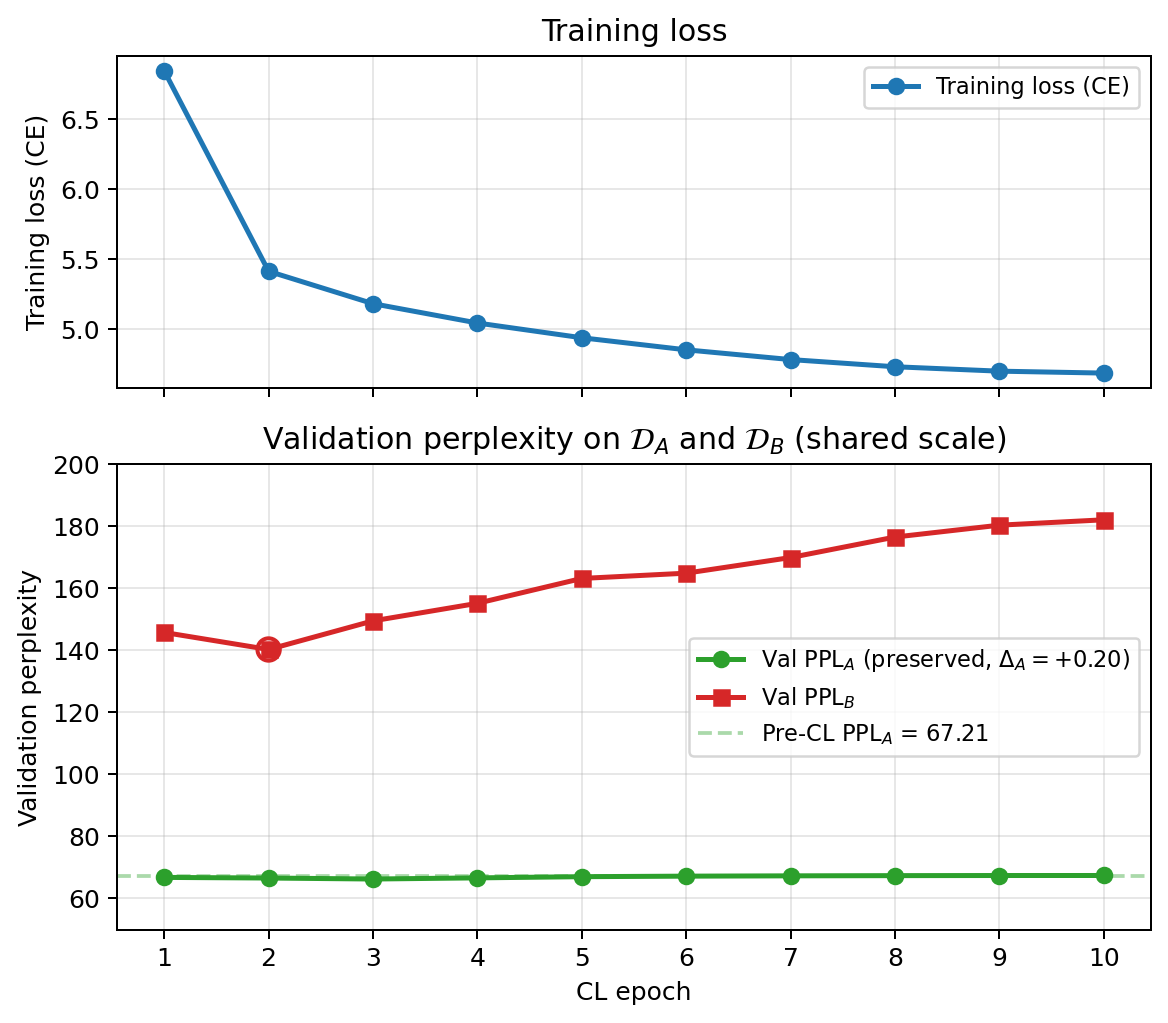
forgetting (ΔA = 0.04) when a 300M model is grown to 857M and adapted across domains, while a
non-function-preserving control forgets an order of magnitude more under the same recipe.
Abstract
We introduce gate-zero growth, a function-preserving (FP) operator for continual learning that adds new residual blocks through a zero-initialised gate. Under a transversality condition, gate-zero growth induces rank separation in the functional Jacobian: old directions are unchanged, new-weight directions are exactly flat at the growth point, and new gate directions are the only first-order source of new functional variation.
As gates open during continual learning, function drift is O(‖α‖²) and Jacobian leakage
O(‖α‖∞), giving a controlled departure from the FP locus. On a 300M→857M Transformer
adapted from WikiText-103 to BookCorpus, gate-zero growth reaches near-zero old-domain forgetting
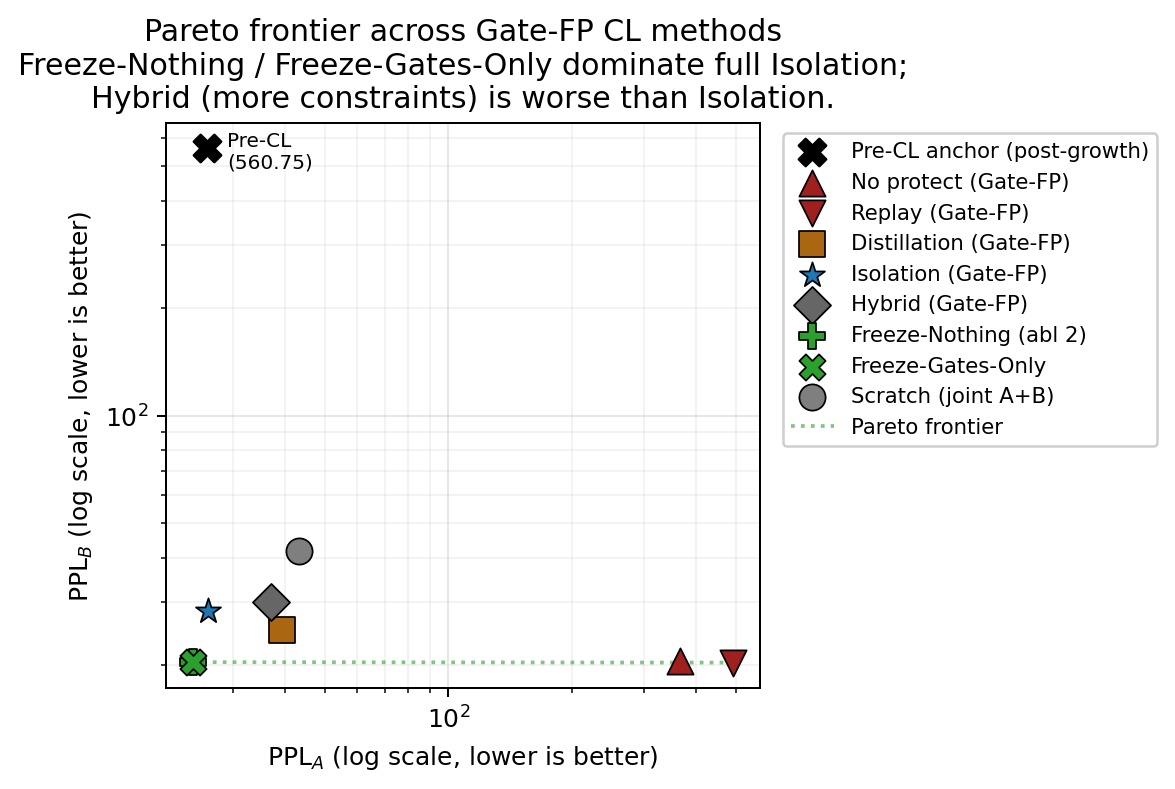
(ΔA < 0.1) under both exact-preservation (Isolation) and joint-frontier (Freeze-Nothing)
operating points, while a non-FP control (Gstack) suffers an order-of-magnitude larger
forgetting under the same recipe. The same geometric analysis covers LoRA, ReZero, and zero-init adapter
constructions, establishing gate-zero growth as the canonical instance of a shared local geometry that
governs safe capacity activation in continual learning.
Overview
At the growth point, take the functional Jacobian of the grown model and partition its columns. The zero gate forces a strict trichotomy — one theorem, three subspaces.
Method
Gate-zero growth is a single operator plus a choice of how much to constrain the old model during adaptation.
- Grow through a zero gate. Insert new residual blocks whose output is scaled by a gate
α initialised at exactly zero. Because
0 · r = 0holds exactly in IEEE-754, the grown network reproduces the original function bit-for-bit — verified as max logit difference0.0. - Rank separation guarantees the geometry. Under a transversality condition, the functional Jacobian at the growth point separates into unchanged old directions, exactly-flat new-weight directions, and gate directions that are the sole first-order source of new functional variation.
- Open gates under control. As continual learning opens the gates, function drift is
O(‖α‖²)and Jacobian leakageO(‖α‖∞)— a bounded, controllable departure from the function-preserving locus. - Pick an operating point. Isolation freezes old weights and gates for exact preservation; Freeze-Nothing trades a little preservation for the best joint frontier. Both reach near-zero forgetting; non-FP growth reaches neither.
Results
A 300M base trained on WikiText-103 (domain A) is grown to 857M and adapted to BookCorpus (domain B). ΔA is the increase in domain-A perplexity after adaptation — forgetting, measured directly.
| Growth × recipe | ΔA (ppl) | FP at growth |
|---|---|---|
| Gate-zero + Isolation | 0.04 | yes — |Δlogit| = 0.0 |
| Gate-zero + no protection | 340.2 | yes |
| Gstack + no protection | 1144.0 | no |
Takeaways
- Function preservation is verifiable, not aspirational. The zero gate gives max logit
difference
0.0— exact, not approximate. - Rank separation explains why it preserves. New capacity is confined to the gate subspace, so old behaviour is untouched until gates deliberately open.
- One geometry, many constructions. LoRA's zero-init
B, ReZero's zero residual scalar, and zero-init adapters are all special cases of the same local structure. - Reproducible by construction. Every randomness surface is seeded, kernels are deterministic, and all 43 result files ship in the repo — with a one-command reproduction of the appendix study.
BibTeX
@article{lok2026gatezero,
  title   = {Gate-Zero Growth: A Geometric Framework for
             Function-Preserving Continual Learning},
  author  = {Lok, Dante},
  journal = {arXiv preprint arXiv:2607.14571},
  year    = {2026}
}